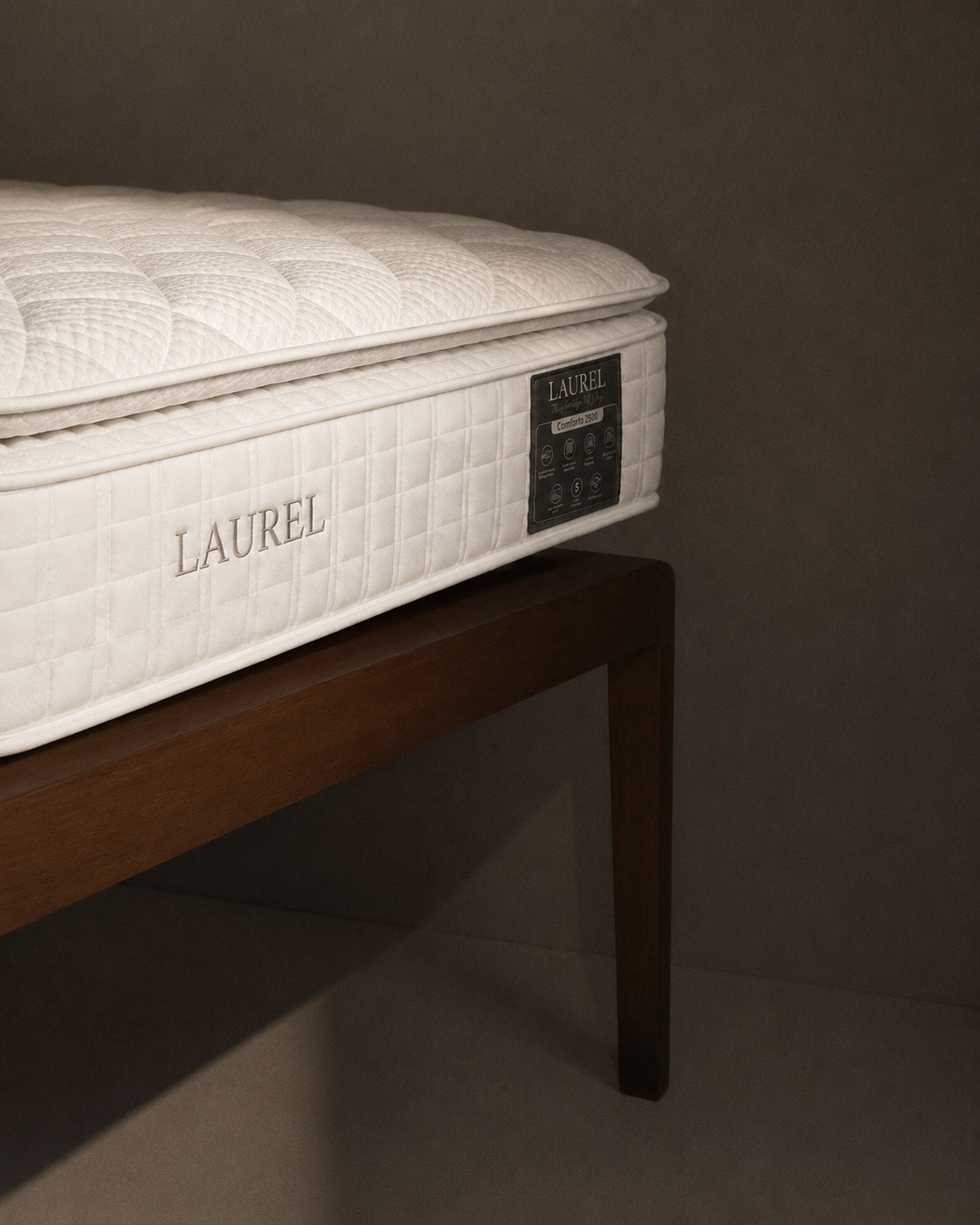
Laurel Comforto 2500 Mattress
Luxury comfort. Exceptional support. Restful sleep.
Two and a half thousand pocket springs beneath a visco memory foam comfort layer — a generous 33 cm, medium-firm mattress designed to hold you gently and support you completely.
The feeling of being held, not laid down
There is a moment, settling into a truly comfortable bed, when the mattress seems to meet you halfway. The Comforto 2500 was designed for that moment — and for the people who want it every night without giving up proper support to get it.
Its method is a partnership. Two and a half thousand pocket springs — each nested in its own fabric pocket — read your body's contours and answer them individually, while a layer of visco memory foam settles over the shoulders and hips, softening the points where a night usually presses hardest. Beneath them, high-density foam holds the whole system steady, so the comfort never becomes collapse.
The result is a medium-firm bed with a gentle first impression: cushioned where you land, structured where you need it, and calm all night — however often the person beside you turns.
Five layers, one intention
Open each layer to see what it does — and how it earns the comfort.
1 Hypoallergenic viscose fabric The plush, breathable first touch
A premium quilted viscose cover — soft against the skin, hypoallergenic by nature, and breathable so the surface stays fresh through the night.
2 Visco memory foam comfort layer Where the pressure melts
Pressure-relieving visco memory foam that warms fractionally to your body and settles around shoulders and hips. Contact is spread across more of you, so no single point carries the night.
3 Spinal support foam The keel of the mattress
A durable, high-density foam layer that aids spinal alignment and gives the memory foam something honest to work against — softness above, structure below.
4 2500 pocket monozone core Two and a half thousand individual answers
2,500 individually encased pocket springs moving independently — each one responding only to the weight above it, for reduced motion transfer and support tailored to your outline, edge to edge.
5 Foam-encapsulated border The frame that never sags
A reinforced foam wall around the entire core that prevents sagging, extends the usable sleeping surface to the very edge, and makes sitting on the side of the bed feel as solid as the centre.
Chosen for the comfort they keep
Nothing inside the Comforto is decorative. Every material answers to pressure relief, support or endurance.
Each spring is nested in its own pocket and moves alone: press one and its neighbours barely stir. That independence is what reduces motion transfer for couples, targets support to your exact outline, and lets the core wear evenly across decades of nights.
Against a lower count at this size: more springs means each carries less load — finer contouring tonight, and more resilience left in reserve for the years ahead.
Visco-elastic foam responds to warmth and pressure, easing you in slowly and spreading your weight across the surface. Pressure points at the shoulder and hip release, circulation continues undisturbed, and the body relaxes sooner — comfort you feel as calm, not softness.
Against a thick all-foam build: the Comforto uses memory foam as a layer, not a bed — you get the contouring without the deep sink or the stuck-in-one-position feel.
The structural layer: it distributes weight, keeps the comfort consistent across the whole surface, and anchors the mattress's medium-firm character. Density is durability — this is the layer that decides how the Comforto feels in its fifth year.
Against low-density foam: indistinguishable in a showroom, entirely different in year three. Density holds its shape; lightness hollows.
A firm foam wall bonded around the spring core. It matters three times a day: getting in, getting out, and every night your sleeping space runs to the very edge without the surface giving way beneath you.
Against a rod edge: rods resist, then fail suddenly at one point. A full encapsulated wall wears gradually, evenly, and with the rest of the mattress.
The layer your skin lives with: plush, breathable viscose, quilted so air moves through the surface as you do. It keeps the microclimate of the bed dry — which is most of what 'sleeping cool' actually means.
Against a sealed synthetic cover: trapping moisture in the comfort layers is the quiet killer of mattress lifespan — and of cool sleep.
Assembled the considered way
A plush, quilted hypoallergenic viscose cover, breathable by construction — the indulgent first touch, engineered to stay fresh and skin-kind.
The 2,500-spring core is seated inside a full foam surround that resists sagging and reinforces the edge — the whole surface sleeps, and the side of the bed holds you when you sit.
Ordered layers over a nested pocket core, assembled once and checked before it leaves — a construction chosen for how the comfort holds in year five. Rotate it regularly and it will keep its welcome.
Who the Comforto serves — and why
The visco memory foam layer exists precisely for the shoulder and hip that ache by morning — contact is spread wide, so no single point carries your weight all night.
Side sleeping concentrates weight on the body's two narrowest ledges. Memory foam lets them settle in while 2,500 springs hold the waist level — a straight spine, lying on your side.
Turn from side to back to front and the pocket core re-maps you each time, while the medium-firm surface never traps you in the shape of your last position.
Individually nested springs absorb movement where it happens. One of you can turn, rise or settle without the news travelling across the bed.
The Comforto's character: an indulgent first impression from the memory foam, held by high-density foam beneath — the cushion never becomes collapse.
If your ideal bed welcomes you softly and then holds steady — neither a plush sink nor a board — the Comforto was tuned for exactly that middle register.
Where the Comforto sits
Tension is not a grade of quality — it is a fit, like a jacket. Here is how to find yours.
Side sleepers are usually happiest from soft to medium-firm, where the shoulder and hip can settle in. Back and front sleepers tend toward medium-firm and firmer, which keeps the hips from dipping.
The lighter you are, the softer the mattress needs to be to respond to you; the heavier, the more support it must hold in reserve. A medium to medium-firm feel, like the Arete's, suits the widest range of sleepers.
The test of a tension is simple: lying in your usual position, your spine should be as straight as when you stand well. Zoned support — firmer under the hips, gentler at the shoulders — does much of this work for you.
A short education in better nights
Why pressure relief matters
Sustained pressure on shoulder and hip restricts circulation, and your body answers by turning — dozens of small awakenings you never remember. Spreading that load is not a comfort luxury: it is how a mattress protects the architecture of your sleep.
How body contouring works
A contouring surface increases the area of contact between you and the bed, so your weight is shared by more of you. Less concentration means less pressure, less fidgeting, and the settled, held feeling the Comforto is named for.
Motion isolation, explained
Movement travels through connected structures. Pocket springs disconnect them: each of the 2,500 responds alone, so a turn on one side of the bed is absorbed within inches instead of rippling across it.
What medium-firm really means
Firmness describes the first impression; support describes what happens beneath it. Medium-firm pairs a cushioned landing with level support — which is why it suits the widest range of positions and partners sharing one bed.
Healthy spinal alignment
Lying in your usual position, your spine should run as straight as when you stand well. The Comforto pursues this from both directions: memory foam lets the wide points settle, high-density foam stops the narrow ones sinking.
Memory foam and warmth
Visco foam responds to body heat, and older all-foam beds earned a warm reputation. Construction is the answer: in the Comforto the memory foam sits as one layer beneath a breathable quilted cover, over a sprung core that air moves through — contouring without the duvet-in-July feeling.
Temperature and deep sleep
Your core temperature falls as you descend into deep sleep, and anything that traps heat resists that descent. A breathable surface and an airflow-carrying spring core quietly help your body do what it already wants to do.
Sleep and recovery
Deep sleep is when muscle repairs, memory consolidates and the day's load is put down. A mattress cannot give you more hours — what it can do is defend the ones you have from the small interruptions that fragment them.
A mattress repays the care it is given
Five quiet habits that keep the Comforto as indulgent as its first night.
Rotate the mattress head-to-toe monthly for its first year, then with the change of each season. Settling is natural; rotation makes it even.
Throw the duvet back for twenty minutes before making the bed. A mattress releases overnight moisture in the first hour of the day — give it the chance.
A washable, breathable protector is the single best investment in the Comforto's long life: it keeps the quilted surface fresh without sealing it.
Vacuum the surface occasionally on low power and spot-clean with a barely damp cloth. Never soak the mattress, and never fold it.
Stand it on a proper base, keep the habits above, and the Comforto will hold its feel deep into its five-year guarantee and well beyond — a well-kept pocket-sprung mattress serves seven to ten years.
The Comforto 2500, precisely
- Depth
- A generous 33 cm luxury profile
- Comfort
- Medium-firm · visco memory foam cushioning
- Support
- High-density support foam · healthy spinal alignment
- Spring count
- 2,500 individually nested pocket springs
- Surface
- Plush quilted, breathable hypoallergenic viscose
- Border
- Fully encapsulated edge support
- Guarantee
- Five years
- Sizes
- Small 3ft · Small Double 4ft · Double 4ft6 · Kingsize 5ft · Super Kingsize 6ft
Everything you might still wonder
Is memory foam hot?
Older all-foam beds earned that reputation. In the Comforto, the memory foam is one layer beneath a breathable quilted viscose cover, sitting on a sprung core that air circulates through — most sleepers find it comfortable year-round. If you know you run distinctly warm at night, the Arete 1500's gel-infused foam is the collection's cooler-running choice, and we would honestly point you there.
How firm is medium-firm?
A cushioned first impression with level support beneath: you settle in, then feel held rather than suspended. It is the most versatile register — soft enough for most side sleepers, supportive enough for backs and fronts.
Will I feel my partner moving?
Far less than on any connected-coil bed. Each of the 2,500 springs is nested individually, so movement is absorbed within inches of where it happens.
How long does it take to adjust?
Give it two to four weeks. Your body has spent years adapting to your old mattress; the first nights on a properly supportive one can feel unfamiliar before they feel inevitable.
Should I rotate the mattress?
Yes — head-to-toe, monthly in the first year and seasonally after. The Comforto is built in ordered layers, so it is rotated through its life, never flipped.
Is it suitable for side sleepers?
Particularly so. The memory foam layer is there for the shoulder and hip, and the pocket core holds the waist level — the combination side sleeping asks for.
How long will it last?
It carries a five-year guarantee against manufacturing defects, and a well-kept pocket-sprung mattress of this construction typically serves seven to ten years. The care rituals above are what make the difference.
Which bases suit it?
All conventional bases — sprung and solid divans, slatted frames with modest gaps, and platform bases.
Two mattresses, two kinds of night. An honest map to choosing between them.
Choose the Comforto for the deeper first impression: visco memory foam over 2,500 nested springs, tuned for pressure relief, side and combination sleepers, and the feeling of being gently held. £824–£1,088.
Choose the Arete for engineered precision: seven zones of graded support and gel-cooled foam, tuned for spinal alignment and distinctly warm sleepers. If you want the mattress to hold a line rather than melt around you, this is your side of the collection. £704–£944.
Visit this mattressThe circulation story behind the shoulder that aches by morning — and how spreading a night's weight changes the way you wake.
What visco-elastic actually means, why the settling feeling is the material working, and how construction decides whether it sleeps warm.
The collection's most versatile tension: who it suits, who it doesn't, and how to judge it the only way that matters — lying down.
Why a turn travels across some beds and stops dead in others: the mechanics of independence inside a pocketed core.
Recovery, mood and memory all run through deep sleep. What defends it — and what quietly fragments it.
The best judge of a mattress is the morning after. We look forward to yours.